Monday, May 25, 2020

On the Cusp of the Cup


1991 Stanley Cup Final, Game 6
Gameday...


For the first time in their history, the Penguins would be playing a game with the Stanley Cup in the building, ready for them to win. But first they’d have to take another game in the resilient North Stars’ raucous home rink.
The mood amongst the players was a good, positive one, recalled Troy Loney. While driving to the rink with Joe Mullen that morning for a team skate, he asked his teammate, Can you feel this? “Joey said, ‘Yeah. We don’t usually get really nervous, but we’re pretty nervous here.’ And then we both said, ‘Yeah but it’s a good nervous.’ We were just on fire at that point, and we knew there was no way we could lose that game.”
According to assistant coach Rick Kehoe, Mario Lemieux was feeling just as confident in the dressing room before the game. “(Defenseman) Grant Jennings was kind of injured and he was on the edge of going or not going that night,” recalled Kehoe. “He said, ‘Well, I should be good for the seventh game.’ And Mario just looked at him and said, ‘Nope. There’s not going to be a seventh game.’”
No one, however, was getting ahead of themselves. They knew how big the task was that lay before them. “Every guy’s got to have the game of his life,” said Phil Bourque. “If everybody does that, it’s going to be worth it."

Excerpted from The Pittsburgh Penguins: The First 25 Years by Greg Enright, available at amzn.to/3cna4N4 or bit.ly/2OGZeYO.


Saturday, May 9, 2020

Pens blast Bruins 7-2 to take command of 1991 Wales Final


Back in Boston for Game 5, the Bruins opened the scoring only 40 seconds in, but the Penguins stayed poised and answered with three goals from Stevens, Lemieux and Trottier. The game became a wide-open affair and the Bruins simply had no hope of keeping up with the high-flying Penguins. 
“It takes a lot from you when they’re coming at you 100 miles per hour,” Bruin defenseman Glen Wesley told the Pittsburgh Press. “It’s tough to stop a team like that.”
Ulf Samuelsson had knocked Cam Neely off his game. Clearly frustrated, the Bruins’ main offensive threat took two retaliatory penalties away from the play, the second of which resulted in one of the Penguins’ three power play goals on the night. When the final buzzer sounded, the scoreboard read Pittsburgh 7, Boston 2. The Penguins were in complete control of the series and but one win away from advancing to their first ever Stanley Cup final.

Excerpted from The Pittsburgh Penguins: The First 25 Years by Greg Enright, available at amzn.to/3cna4N4 or bit.ly/2OGZeYO.


Saturday, April 25, 2020

Mario's playoff magic puts a hex on the Flyers


The Penguins and Flyers faced off in Game 5 of a deadlocked Patrick Division Final. It would be a night of hockey history, thanks to "Le Magnifique":

At 2:15 of the first period, Lemieux snuck behind the Philly D, deked Ron Hextall with the slightest of fakes and backhanded the puck into an empty net to make it 1-0. Ninety seconds later, standing completely unmolested at the side of the Flyer net, Mario took a Bob Errey pass and directed it home for a 2-0 Pens lead. Just before the seven-minute mark, Lemieux again gained a step on the suddenly slothful Flyers’ defense and, fading to his right side, rifled a pinpoint wrist shot to the far side of Hextall’s net, beating him cleanly.

The Igloo exploded in joy. Lemieux had clearly taken his game to another level and the Flyers seemed helpless to stop him. After Errey made it 4-0 only 12 seconds after Lemieux’s hat trick goal and ex-Pen Mike Bullard answered back for the Flyers, Mario scored his craftiest goal on the night. Seeing Hextall venture behind his net for a loose puck, Lemieux swooped in and, with his long reach, stick-checked the big goalie, took the puck around the net and swept it into the open cage.
Lemieux would add three assists and an empty-net goal to tie the NHL single-game playoff records for goals with five and points with eight, leading the Pens to a 10-7 win. He also tied a few single-period NHL post-season records: most goals (four), most points (four), and assists (three). His final goal also set a new Penguin mark for career playoff goals at 10, one more than Jean Pronovost. Incredibly, it had taken Lemieux less than two playoff rounds to accomplish the feat!
“He elevated his game to the point where he just showed everybody else how much better than us he can be,” observed Tom Barrasso.
Even the Flyers were in awe of the display.
“I’ve never seen an individual performance like that,” said coach Paul Holmgren. “We just got in front of that snowball with the Number 66 on it early, and when he gets rolling, it’s a scary thing.

Excerpted from The Pittsburgh Penguins: The First 25 Years by Greg Enright, available at bit.ly/2OGZeYO or amzn.to/3cna4N4 


Saturday, April 18, 2020

Pens score fastest 5 goals in NHL history


The good times kept rolling for the Penguins on November 22, 1972 when, playing at home against the St. Louis Blues, they set an NHL record that still stands to this day. 
The game was a typically close battle between the bitter expansion rivals for the first two periods, with the Pens holding a 5-4 lead with a little over eight minutes to go. Bryan Hextall widened the lead by tipping in a Jack Lynch slap shot at 12:00. Jean Pronovost then took a feed from Greg Polis 12 seconds later and buried it past Blues goalie Wayne Stephenson. Al McDonough completed a hat trick at 13:40 off a pass from Syl Apps to make it a rout at 8-4. 
The crowd of 12,405 had barely started celebrating that marker when Ken Schinkel lit the lamp only nine seconds later. The shell-shocked Blues could not pull themselves together enough to stop Schock from adding a tenth goal only 18 seconds later.
The traditionally goal-starved Penguins had scored five goals in only two minutes and seven seconds, easily obliterating the previous mark for fastest five goals by one team of three minutes, forty-six seconds set by the Rangers in 1942. The fourth and fifth of those Penguin goals, only nine seconds apart, set a new team record for fastest two goals, and the overall tally of 10, in a 10-4 win, marked the first time the Pens had gone into double figures.
“Our guys were driving,” observed GM Jack Riley. “They seemed to have an obsession like Rocket Richard used to have to get down toward the goal and to get a shot. Everything seemed to be going our way.”

Excerpted from The Pittsburgh Penguins: The First 25 Years by Greg Enright, available at bit.ly/2OGZeYO or amzn.to/3cna4N4 

Sunday, January 27, 2019

Penguins play last game in blue against black & gold Bruins - Jan. 27 1980

The Penguins' last game wearing blue uniforms as their primary color scheme took place on January 27, 1980 in Boston against the Bruins. Since entering the NHL in 1967, the Pens had worn various combinations of dark blue, baby blue and white. But thanks to the success of the black-and-gold-clad Steelers and Pirates, champions in football and baseball, respectively, Penguin ownership decided it was time the Pens followed suit.

“Our fans practically demand it,” team vice-president Paul Martha told a local newspaper. “Anything we can do to make going to a hockey game more entertaining, we’ll try.”


The idea took definite shape when the Penguins sent formal notice to the league in January 1980. The NHL quickly approved the move, but the sartorial switch hit a snag when the Bruins protested, claiming they had sole NHL rights to the black and gold colors. 


The hissy fit from the Hub was doomed to failure, though, what with no legal basis to support it. NHL President John Ziegler formally denied the challenge when he ruled that the Pittsburgh Pirates, the Steel City's first NHL team that played from 1925 to 1930, had worn black and gold eight years before the Bruins switched to the scheme in 1933.


So it was with some irony that the Pens played their final game in blue against the team that had opposed their move to black and gold. What's even more incredible is that the Penguins came out of the Boston Garden victorious - a feat they had accomplished only three other times in their entire existence (3-27-2). Center Greg Malone led the way with two goals and an assist. The win snapped a five-game losing streak.


"Things weren't going too good for us," Gregg Sheppard told the Boston Globe. "So we were trying anything. Maybe we took more chances."


Three nights later, the Penguins wore black and gold for the first time at home against the St. Louis Blues. The jerseys had just arrived from the place the Penguins had ordered them from - where else? - the  Bruins Pro Shop in Boston Garden.


Follow me on Twitter: @penguinshistory and @NHLNewsArchive.


Monday, December 25, 2017

The Penguins of Christmas past

In the early days of the Penguins franchise, the team often played games on Christmas Day. Unlike today’s NHLers who enjoy a nice three-day break, players back in the day had to work on December 25th. In the late sixties and early seventies, team owners still called the majority of the shots and if they wanted their products on the ice on December 25 there was no players union powerful enough to say different.
The Pens played four Christmas games in their first five years – and did quite well. Here’s a recap of their holiday hockey playing:
Jean Pronovost chases Gordie Howe,
Christmas Day 1968.
  • In the Penguins’ first season, 1967-68, they met the Los Angeles Kings at the Civic Arena and came out on top 4-3 thanks to a pair of goals each from Andy Bathgate and Gene Ubriaco. It was their first win in five tries against their expansion brethren from Southern California.
  • The following year, before the smallest home crowd to that date to see a Pens game (2,420), the home team stormed back from a 3-1 deficit to beat Gordie Howe and the Red Wings 6-3. Keith McCreary was the hero, scoring both the tying and winning goals.
  • Two years later, the Penguins ran into the most powerful line in hockey when they visited Boston Garden. Wayne Cashman, Phil Esposito and Ken Hodge accounted for four goals en route to an 8-4 pasting of the Pens. Esposito alone had 13 shots. “That’s more shots than my whole team gets sometimes,” quipped Pittsburgh coach Red Kelly afterward. The Penguins did exact some revenge the next night when they beat the Bruins 4-2 back at the Igloo.
  • In 1971, with the Pens struggling through an eight-game winless streak, the high-flying Montreal Canadiens came to town. Mercifully for the Penguins, the Habs opted to start backup goalie Denis DeJordy over Ken Dryden. Pittsburgh burned him for four goals and the Penguins had their first win since December 4, coming out on top 4-2.
That day marked the end of Christmas hockey in the NHL. The league stopped the practice, and a year later phased out Christmas Eve games as well. The Penguins finished with a 3-1 mark, including two wins against established teams – not too bad for a fledgling expansion club.

Wednesday, May 18, 2016

The three biggest keys to the Penguins winning the Stanley Cup

There are a number of big things that should ideally happen if the Pens are to drink from Lord Stanley’s mug this spring, like the power play consistently clicking, Crosby and  Malkin scoring more, avoiding dumb penalties and getting a bit more luck than their opponents. But if they take care of the main three below, these other ones should eventually fall into place, and we could very well see another Cup coming to Pittsburgh as a result.

Ferocious Forecheck: Coming in with speed and power will get you the puck more often than not and a key to the Pens' success all spring has been their ability to do this consistently. The Crosbys, Kessels and Malkins will bury enough of the pucks they get. Keep getting them the pucks and the goals will come. Do not let up. 

No Matt Mulligans: Matt Murray must keep playing his technically sound, even-keeled game. It's the only kind of goaltending that wins Stanley Cups. And the brutal reality is that we're at a point in the playoffs where Mulligans are not permitted. The reassuring thing here is that the Pens have a former Stanley Cup winner as a backup. 

No 'D'-fects: Some of the younger D-men like Olli Maata and Brian Dumoulin have to avoid sloppy clearances in their own zone that land on opponents' sticks. They haven't always succeeded at that in these playoffs. It is the single biggest cause for concern for the Penguins and their fans. Overall, though, they've played beyond their years, but they must play about a year older the rest of the way. Let Letang score from the back end. Let the superstars be super up front. Just get that puck out of your zone, boys - again and again. 


Thursday, May 5, 2016

1991 Wales Final Game 3: Pens 4, Bruins 1

The Penguins channeled their frustration stemming from a Game Two overtime loss into a passionate but focused effort that resulted in a 4-1 win, bringing them back into the Wales Conference Final and cutting Boston’s series lead to two games to one.
Ulfamania was a Penguin Pest all night long.

With the Pens leading 2-0 halfway through the second period, Boston’s Ray Bourque got one back when he converted a Cam Neely pass, firing a hard shot behind Tom Barrasso. Their celebration didn’t last long, though, as low-scoring defenseman Grant Jennings answered right back 16 seconds later, putting a Mario Lemieux rebound in the back of the Boston net, sending the sellout Igloo crowd into delirium. Lemieux added one himself before the period was out, and Tom Barrasso stopped all 12 Bruins shots in the third to ice the victory.

“We’re back in the series,” said Boston native Kevin Stevens, the Pens left winger who had boldly predicted a Penguins series win after the Game Two loss. “And we’re confident we can win the series. The other night was frustrating because we played well enough to win. But I know this team believes in itself.”

Aside from the result, a hot topic of conversation after the game was Ulf Samuelsson’s knee-on-knee hit on Neely in the second period. The collision left the Bruins steaming. “I thought it was a real cheap shot on Cam,” said Boston defenseman Garry Galley, “the way he stepped up and really went for that (knee) area.”

Ultimately, though, Bruins coach Mike Milbury had to admit that his team had been outmatched on this night. “Tonight they were too much for us and we didn’t have the answers.”

Check out highlights of this game here

  • Samuelsson hit on Neely is at very beginning 
  • Spectacular Mario Lemieux goal at 0:52
  • Interviews follow later.

Tuesday, May 3, 2016

1991 Wales Final Game 2: Bruins 5, Pens 4 (OT)

The Penguins entered the third period trailing 3-2 but goals less than two minutes apart midway through the period by Mark Recchi and Mario Lemieux gave Pittsburgh their first lead of the night. With only 3:11 left, however, Craig Janney converted a pass from Vladimir Ruzicka during a 5-on-3 man advantage to send it to overtime.

It was Ruzicka’s fourth assist of the night. But “Rosie” wasn’t done yet. At 8:14 of the extra period he found himself alone with the puck in the Penguins crease and fired it over a fallen Tom Barrasso to give the Bruins the win and a 2-0 series lead.
"I'll say it right now, we'll beat them."

In the dressing room, the Penguins weren’t disheartened. If anything, the loss hardened their resolve to take the series back.

“We all have our highs and our lows, and right now the Bruins are living a high,” defenseman Gordie Roberts told Dave Molinari of the Pittsburgh Press. “But hopefully we’ll bring them back down to earth the next game.”

Left wing Kevin Stevens went even further, issuing his famous guarantee.

“We’re confident we can beat this team,” he said. “And we will beat this team...We’ll beat this team. I’ll say it right now, we’ll beat them.”

Stevens and the rest of the Penguins would have to start making that promise a reality in Game 3 back in Pittsburgh two nights later.

You can see highlights of this game here.

Sunday, May 1, 2016

1991 Wales Final Game 1: Bruins 6, Pens 3

Sloppy turnovers cost the Penguins in Game One at Boston Garden, their first semi-final game since 1970. The Pens were as close as 4-3 in the third period but goals by Dave Christian and Ray Bourque put the game out of reach.

Defenseman Gordie Roberts sounded a note of optimism after the game, however.

“You can’t give Boston’s key players a chance to make big plays. But we’ll get better as the series goes on. We’ll get used to this building.”

It was a building that had not been kind to the Penguins historically. Heading into the game, they sported a woeful 7-42-6 record, regular season and playoff games combined.

What would develop into an rather intense coaches war throughout the series got rolling right off the bat. Pens bench boss Badger Bob Johnson was none too pleased with the Bruins’ delay tactics aimed at – in Johnson’s view – allowing star defenseman Bourque to get sufficient rest between whistles.

“They want Bourque out there all the time,” he said. “They’re talking to the referee, sending six guys out all the time. Watch ‘em. When Bourque gets tired they have a delay. The job of the referee is to keep the game moving.” 

Friday, April 29, 2016

1991 Patrick Final Game 5: Pens 4, Caps 1

The Pens jumped out to a 1-0 lead on a Joey Mullen goal at 15:38 of the first period but had to kill off a Washington 5-on-3 advantage for 1:34 at the beginning of the second. That they did, and shortly after it had ended, Ron Francis put the Pens up 2-0 – a hard blow for the Caps to take.
 
Dave Tippett got one back for the Capitals before the second period ended, but Jaromir Jagr provided some much-needed insurance at 7:53 when he scored on a highlight-reel rush from centre ice. Mark Recchi added an empty-netter and the party was on.
 
The Penguins had won two playoff series for the first time in their history and would now advance to the Wales Conference Final.
 
“We’ve really put things together and made a tremendous turnaround from last year. And we’ve got a chance to go far,” said goalie Tom Barrasso, who turned in another brick-wall performance, stopping 33 of 34 Washington shots.
 
The Penguins were half-way to the Stanley Cup.
 
“We’ve climbed two mountains already,” said coach Bob Johnson. “But we’ve got two more mountains to climb.”


Thursday, April 28, 2016

1991 Patrick Final Game 4: Pens 3, Caps 1

Through the first five months of the Penguins’ 1990-91 regular season, the “Option Line” of John Cullen, Kevin Stevens and Mark Recchi provided a huge offensive spark that helped the team win its first division championship. The line had clearly clicked, but when Cullen was traded to the Hartford Whalers in March, it had lost its centreman.
 
Fortunately for the Penguins, they had a pretty fair replacement as they finished the season and moved into the playoffs: a guy named Mario Lemieux.
 
The Pens superstar captain returned at the end of January after sitting out the entire season to that point with back problems. After the Hartford trade, Number 66 frequently moved into the spot vacated by Cullen, often with magical results.
 
Case in point: Game 4 of the Patrick Division Final against the Washington Capitals, in which the three linemates combined for seven points in a 3-1 victory that gave the Pens a 3-1 stranglehold on the series.
 
Tom Barrasso turned in a superlative performance, stopping 38 of the 39 Capital shots. Washington outshot the Pens overall, 39-19.
 
“Barrasso played extremely well. He was the difference,” said Caps defenseman Rod Langway. “They kept the puck on the outside and let Barrasso see it.”

Tuesday, April 26, 2016

1991 Patrick Final Game 3: Pens 3, Caps 1

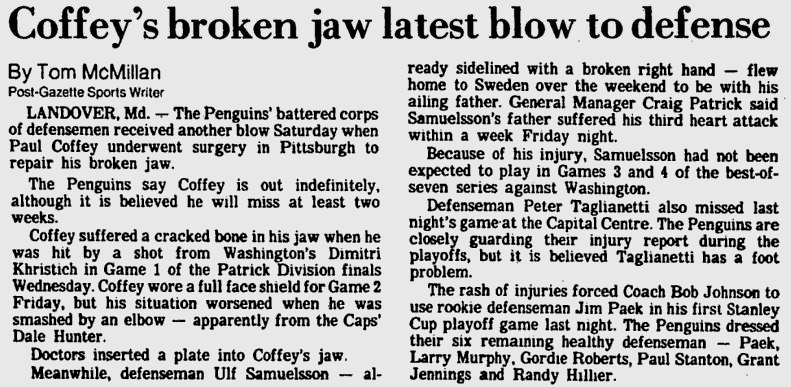
With three of their regular defensemen out of the lineup – Paul Coffey with a broken jaw, Ulf Samuelsson with a broken hand and away in Sweden to visit his ailing father, and Peter Taglianetti hobbled with a bruised ankle – the Penguins turned to a trio of backup blueliners to hold down the fort. 

Gordie Roberts, Paul Stanton and Jim Paek, making his career playoff debut, played a simple yet solid game and allowed the club to come out with a 3-1 win and a 2-1 lead in their Patrick Division Final series against the Washington Capitals. 
Tom Barrasso returned to the Penguin net, and goals from Mario Lemieux, Kevin Stevens and Bryan Trottier gave Pittsburgh a well-earned playoff road victory.

“Losing three players like that, we needed good goaltending and we needed good backchecking. I think the team rallied around that,” said coach Bob Johnson.

Sunday, April 24, 2016

Coffey suffers broken jaw, April 17 1991


The Penguins' 1991 playoff run took a big hit when Paul Coffey suffered a broken jaw in Game 1 of the Patrick Division Final vs. the Washington Capitals. He joined two other starting Pens D-men on the sidelines:


1991 Patrick Final Game 2: Pens 7, Caps 6

The Pens came out on the winning side of a good old-fashioned early 90s shootout, thanks to Kevin Stevens’ bullet-like wrist shot that bulged the twine behind Mike Liut at 8:10 of overtime.
 
Stevens had received a perfect tape-to-tape pass from Ron Francis before firing home the winner. “I was just going to the net,” said the power forward. “I knew Ronnie was coming to me. I just banged it in.”

The Penguins had blown a 5-3 lead in the third period and needed a tying goal from Randy Gilhen with just over five minutes left on a delayed Washington penalty to send it to OT. Ulf Samuelsson left the game after two periods after apparently reinjuring his broken right hand. Frank Pietrangelo was again in the Penguins net in place of injured starter Tom Barrasso.

1991 Patrick Division Final tied 1-1


Thursday, April 21, 2016

1991 Patrick Final, Game 1: Caps 4, Pens 2

Mario Lemieux and Ulf Samuelsson return to the lineup but it isn’t enough to stop the hard-working Capitals from grabbing a 1-0 series lead and home ice advantage.

“I thought momentum from [the Game 7 win over New Jersey] would carry over,” said a disappointed coach Bob Johnson, “but they’re a well-rested team and they won a lot of loose pucks.”

The Capitals had knocked off the New York Rangers in six games to reach the Patrick Division Final, overcoming a 2-1 deficit.

The Pens led 2-1 heading into the third but allowed Kevin Hatcher to tie it 1:37 and another defenseman, Al Iafrate, to pot the winner at 15:31. An empty-netter sealed it.

“They outworked us. They wanted it more than us,” said winger Bob Errey.

(Interesting piece of Pens trivia: the official scorer for the game was Bernie Boileau, brother of former Penguins coach Marc Boileau. He was part of the Montreal off-ice officiating crew that was working the game.)

Saturday, April 16, 2016

1991 Patrick Semi-Final, Game 7: Pens 4, Devils 0

Paul Coffey's return provided an emotional lift
for the Penguins in game 7.
The Penguins finally put it all together against New Jersey in Game 7 of their Patrick Division semi-final series and dominate the Devils from the opening faceoff to the final whistle. Paul Coffey is a surprise starter after getting clearance from the doctors on his injured eye, which had been high-sticked earlier in the series. 

The Pens led 2-0 after one and rode another fine performance from backup goalie Frank Pietrangelo to move on to the second round and a date with the Washington Capitals. And they did it without captain Mario Lemieux for the final 40 minutes, who had to leave with back spasms.
 
“It shows a lot of heart, a lot of character, the way we came back,” winger Phil Bourque told the Pittsburgh Press in the post-game locker room. “It’s probably uncharacteristic of the Penguins in the past, but this is a whole different team.”

Friday, April 15, 2016

1991 Patrick Semi-Final, Game 6: Pens 4, Devils 3

With starting goalie Tom Barrasso unable to go after injuring his shoulder in Game 5 of their 1991 Patrick Division semi-final series, the Penguins turned to backup Frank Pietrangelo in a game that saw their season on the brink. Down three games to two, Pittsburgh would have to win in enemy territory to send it back to the Steel City for a decisive Game 7…or get their golf clubs shined up for a long summer.
 
Pietrangelo’s first NHL playoff game got off to a shaky start when a pass from behind his net by Devils winger John MacLean caromed off defenseman Larry Murphy’s skate and into his net at 3:29 of the first. Fortunately for the Pens, Mario Lemieux was clearly on his game this night, controlling the play whenever he stepped on to the ice. The Penguins kept their composure and tied the game on a Kevin Stevens snap shot at 10:49. Stevens then added a power play marker to give the Penguins the lead.
 
And then…it happened: “The Save.”
 
With the Devils pressing, Peter Stastny was ready to fire home what surely looked liked the tying goal, with the puck on his stick and half an empty net at which to shoot. Well, almost empty. There was Pietrangelo’s glove stretched out to cover a minute part of the gaping cage, and that’s just where Stastny put it.
 
The Devils had their sticks in the air. The Meadowlands crowd was already cheering. But there was no goal to celebrate, thanks to the backup’s incredible grab, still widely recognized as the greatest save in Penguins history.
 
“He hit my glove. It’s not a matter of a skill save, it’s a lucky save,” said a humble Pietrangelo later. He added, though, that “lucky or not, a save like that is a big lift for the team.”
 
From there, the Penguins built a 4-1 lead and held on for a gutsy 4-3 win. The Devils looked to have tied it late when Laurie Boschman directed the puck into the Pens net. The replay showed it went off his skate and then his stick, which would have been a legal goal. However, referee Bill McCreary had ruled it was directed in by Boschman’s skate and waved it off.
 
It was back to Pittsburgh for a winner-take-all Game 7.

1991 Patrick Semi-Final, Game 5: Devils 4, Pens 2

After a listless first two periods, the Penguins woke up in the third. Ron Francis scored his first playoff goal as a Pen and set up another within 2:47 to pull Pittsburgh even. They kept coming, only to be repelled by goalie Chris Terreri on a number of quality chances. When Randy Hillier was called for a questionable hold at 11:15, Claude Lemieux capitalized by tipping Kirk Muller’s pass into the Penguin cage. Doug Brown added an empty-netter to push the Pens to the brink.

Coach Bob Johnson maintained his usual optimistic outlook, however. “You can lose three games and still win the series. We’ve lost our three,” stated the Badger.


The players fed on their coach’s upbeat attitude, appearing to be focused on the task of going to New Jersey and starting to climb out of the hole they’d dug for themselves. “It doesn’t even have to be a pretty one,” said defenseman Larry Murphy about the upcoming Game Six. “We’ve just got to go in there and find a way.”