
Sunday, October 18, 2015
Dale Tallon's career closes in Pittsbugh
At the 1970 NHL Entry Draft, the league’s two new teams, the Buffalo Sabres and Vancouver Canucks, participated in a roulette-style spinoff to determine which club would claim the first overall pick. The Sabres won it and took future Hall of Famer Gilbert Perreault. The losing Canucks chose second and went with defenseman Dale Tallon.
It was a fateful spin for both teams. The Sabres were in the Stanley Cup Final within five years, while the Canucks languished in (at best) mediocrity for years. Tallon was no Perreault and lasted only three seasons in Vancouver before being traded to the Chicago Black Hawks, where he enjoyed his most productive days.
Tallon was traded to Pittsburgh in October 1979 for a second round draft pick. "Tallon has a lot of class,” said Pens GM Baz Bastien at the time. “He had some great years in Vancouver and two big years in Chicago,” he said, somewhat overstating the hockey facts.
Talon, who also played center at times, was enjoying a decent season and had settled in well with his new teammates when on March 13, 1979, ironically during a game in Vancouver, he lost his footing while charging to the Canucks net and crashed into the goalpost. Broken leg. Season over.
He wouldn’t make it back to the lineup until late December of the following campaign, but two other smaller ailments sent him back to the sidelines. He’d return to play in the Pens' opening round playoff series against the Boston Bruins, but his tank was empty. Those games would turn out to be his last in the NHL.
A career that started in 1970 with so many huge expectations concluded a decade later, largely unfulfilled, in the black and gold of the Pittsburgh Penguins.
(Happy) Epilogue: Tallon has since gone on to a successful front office career in the NHL and is the current GM of the up-and-coming Florida Panthers.
Greg Enright is a writer, editor and Pens fan since the days of the blue uniforms. Follow him on Twitter @penguinshistory.
Friday, October 16, 2015
Paiement closes career as a Penguin

The Scouts, however, had little else in the way of talent and could barely win a handful of games. After two dismal years in K.C. the team moved to Colorado to become the Rockies, and Paiement went along with them. The scenery changed but the losing continued. Paiement put up some impressive numbers nonetheless, tallying 40 goals in 1976-77 and 87 points the following year. In 1979 he was traded to the Toronto Maple Leafs in the infamous deal for Lanny McDonald, and two years later he went to the Quebec Nordiques.
After one-season stops in New York with the Rangers and Buffalo, Paiement's hockey road wound its way to the Penguins, where he was penciled in as Mario Lemieux's right winger on the Pens' top line to start the 1987-88 campaign.
Paiement got off to a solid start, scoring a goal in each of the team's first two games, but after that it was all downhill. He was demoted to the Penguins' farm team in Muskegon in mid-November - his first ever stint in the minors.
"After we took him off the power play he seemed to stop working," said Pens GM Eddie Johnston at the time. "He definitely hasn't played up to expectations."
Paiement did return for six more games in January but with a nagging knee injury and little production (1 assist in those six games) the writing was on the wall. Wilf Paiement played his final NHL game January 10, 1988 wearing a Penguins uniform - a 7-5 loss to the Red Wings in Detroit.
Thursday, October 15, 2015
Lemieux bags 8 points vs. Blues

The Blues put up little fight, registering only 22 shots. "After [the Blues'] second goal, I was a spectator. And I had a great seat," said Pens goalie Steve Guenette.
Some of Lemieux's other teammates were getting used to their teammate's heroics, however. Defenseman Zarley Zalapski admitted he wasn't even aware of Number 66's point total, while Rob Brown, who was the happy recipient of Lemieux's passing, scoring his first career hat trick, said "It's Mario Lemieux. You expect it. If he only gets three or four points, you think he has a broken leg."
For his part, Lemieux was ready to move on. "It was a great game, but tomorrow I have to forget about it."
Wednesday, October 14, 2015
Oct 5/90: Pens 7, Caps 4

The 1990-91 Penguins opened the season on the road against the
Washington Capitals on October 5, minus superstar captain Mario Lemiuex, who was out indefinitely with an inflammation in the disc area of his back.
Despite new coach Bob Johnson’s emphasis on defense in training camp, the game turned into a wild affair with Pittsburgh outgunning the hosts 7-4. Left Wing Keving Stevens and his centerman John Cullen each turned in Mario-like performances, Stevens getting a whopping two goals and four assists, while Cullen tallied five assists.
Despite new coach Bob Johnson’s emphasis on defense in training camp, the game turned into a wild affair with Pittsburgh outgunning the hosts 7-4. Left Wing Keving Stevens and his centerman John Cullen each turned in Mario-like performances, Stevens getting a whopping two goals and four assists, while Cullen tallied five assists.
It was the team’s overall resiliency that brought a smile to
Johnson’s face, however. “The ability to come back in their building is the
thing that please me,” said the coach.
1990-91 record: 1-0-0
Thursday, July 16, 2015
Pittsburgh Pirates: The final uniform

In this era, game-action images were rare in newspapers. When there was imagery to go along with a story, it was usually a posed shot such as this one. I've never seen such a clear picture of a member of the Pirates sporting this style of uniform, though. The details really jump out at you.
The Pirates had almost as many uniform styles (three) as they did seasons in the league (five). This one was black and orange and in many respects was way ahead of its time. Notice the diagonal striping, similar to the original Mighty Ducks of Anaheim jerseys, and the pirate logo on the front left pant leg, which to my knowledge wasn't widely used until the 1980s.
For my money, you can't beat the Pirates' original black and gold uniforms, but this shot proves just how much of a winner the final version was - even if the team wasn't.
Tuesday, July 14, 2015
Chuck Arnason
Arnason came to the Pens on January 4, 1974 in a trade with the Flames, putting up a respectable 18 points in 41 games. The next year, skating on a line with 31-goal rookie star Pierre Larouche and Bob Kelly, Chuck hit his stride, racking up 26 goals and 58 points. The Penguins were back in the playoffs, and in the first game of the best-of-three first round series against the St. Louis Blues, Arnason turned in perhaps the finest game of his career.
Trailing the Blues 2-1 in the third period, Arnason scored two goals to cue a come-from-behind 4-3 Pittsburgh victory. His second goal, in which he put in his own rebound to tie the game at three, mightily impressed Penguin coach Marc Boileau. "I've never seen a goal like that," he said after the game. "It was some wrist shot."
Trailing the Blues 2-1 in the third period, Arnason scored two goals to cue a come-from-behind 4-3 Pittsburgh victory. His second goal, in which he put in his own rebound to tie the game at three, mightily impressed Penguin coach Marc Boileau. "I've never seen a goal like that," he said after the game. "It was some wrist shot."
By early 1976, though, Arnason had fallen out of favour with the Pens brass, who reportedly wanted him to go into the corners more and play better defense. On January 9, 1976, he was shipped to Kansas City along with bad boy Steve Durbano. Thus began a tour of the NHL dregs, although he did have one solid stop in Cleveland, where in 1977-78 he scored 21 goals in 40 games for the Barons.
Those would be the last goals of his NHL career, however. During training camp in 1980, Arnason suffered a serious knee injury. It was time to let the curtain fall on his hockey playing days.
Arnason's son Tyler also made it to the NHL, playing 487 games with the Blackhawks, Senators and Avalanche from 2001 to 2009.
Monday, July 13, 2015
Kevin McCarthy, Pens point man
Kevin McCarthy was a high-scoring NHL defenceman of the late 70s and early 80s who began and ended his career with the Philadelphia Flyers, playing for Vancouver and Pittsburgh in between. Drafted 17th overall in the 1977 amateur draft, McCarthy had an impressive rookie season in 77-78, putting up 17 points in 62 games, while enjoying a plus-29 rating.

After 22 games and only three points the next year, however, the Flyers gave up on him and shipped him to Vancouver.
He proved the Flyers wrong.
Seasons of 45, 53, 45 and 40 points followed. Unfortunately, he broke his ankle just before the Canucks began their memorable run to the Stanley Cup Finals in 1982, missing the entire playoffs and watching his team eventually lose to the New York Islanders.
McCarthy came to the Penguins smack dab in the middle of their worst season ever, traded in January 1984 for a third-round pick in that year’s draft. He hadn't been playing much in Vancouver and welcomed a fresh start in Pittsburgh. "I'm glad to be with someone who wants me," he said when traded. "It could be a blessing in disguise because (Pens GM) Eddie Johnston said I'd be getting a lot of ice time."
McCarthy proved to be a rare bright spot for the Pens that year, racking up 20 points in 31 games. Typical of most 1983-84 Penguin defencemen, though, he also posted a hideous minus-32 while wearing the black and gold that year.
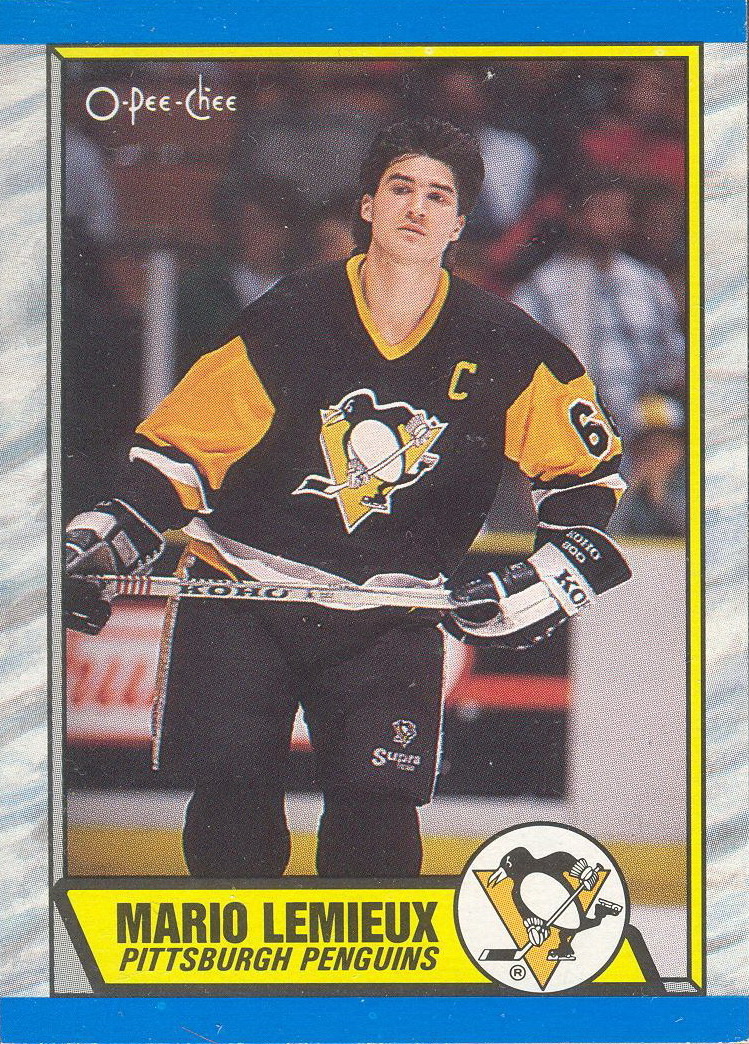
McCarthy was back the following season to be a part of Mario Lemieux’s rookie campaign, but the following summer his career went full circle when he was signed by the Flyers as a free agent. After six more games over the next two years, McCarthy’s NHL career was over.
Since hanging up his skates, McCarthy has enjoyed a successful coaching career, getting his name on the Stanley Cup as an assistant with the 2006 champion Carolina Hurricanes. He is currently an assistant coach with the Nashville Predators.
Subscribe to:
Posts
(
Atom
)